
Paper-Based Packaging Inserts for Luxury Skincare: Replacing EVA Foam
A luxury skincare brand wanted to replace its EVA foam insert with paper-based packaging inserts while maintaining stable support for heavy glass bottles and a clean visible surface inside the rigid gift box. HS PACKFACTORY developed a hybrid structure using a custom molded pulp base beneath a die-cut paperboard top layer.
The project required more than exchanging one material for another. The new insert had to support the bottle bases, separate the glass containers, protect labels and closures, align with the outer rigid box, remain practical to assemble, and withstand export packing without excessive deformation.
This case study describes the transition from EVA foam to a paper-based insert system. It does not automatically mean that the complete skincare packaging set, product containers, coatings, adhesives, labels, magnets, or export materials are plastic-free. Any “100% plastic-free,” recyclable, compostable, or FSC® claim must be confirmed against the final material specification and supporting documentation.
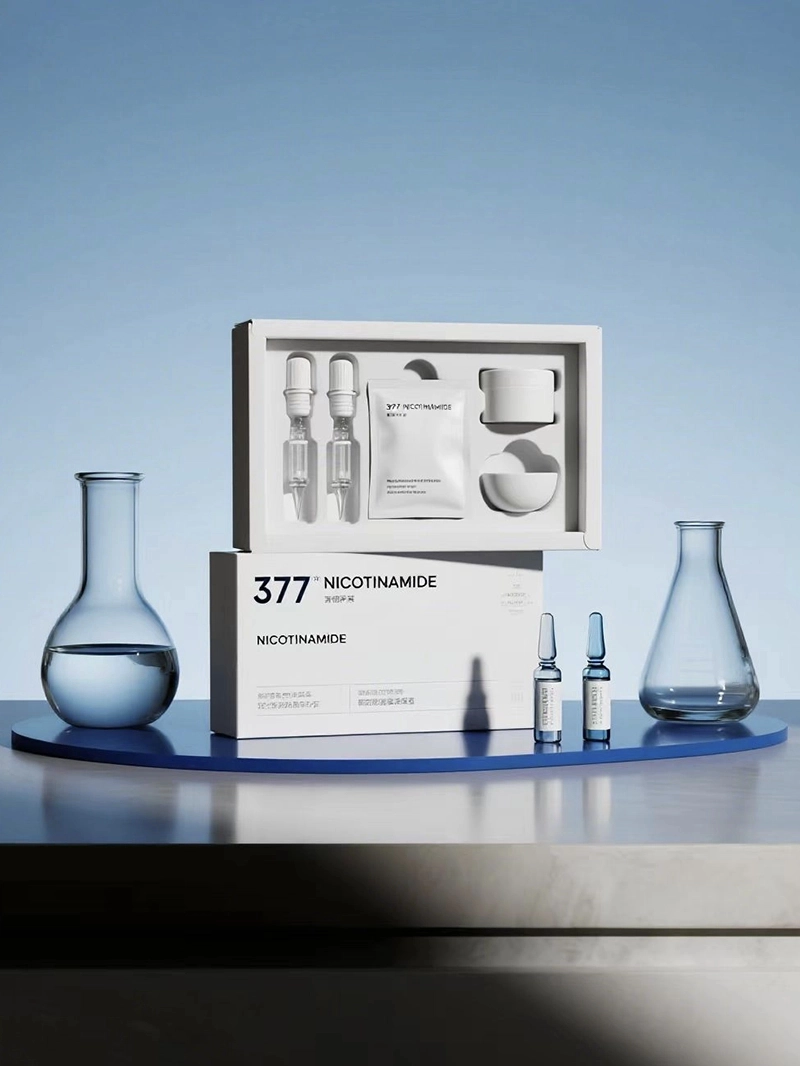
Quick Answer: Paper-Based Packaging Inserts
Paper-based packaging inserts can replace EVA foam in many skincare, cosmetic, candle, glass-bottle, and gift-set projects when the cavity design, material strength, bottle contact points, visible finish, and export packing are physically tested before production.
- Molded pulp: Creates shaped cavities and three-dimensional support around bottles or jars.
- Die-cut paperboard: Provides a smoother visible top surface and cleaner bottle openings.
- Hybrid structure: Combines hidden molded-pulp support with a paperboard presentation layer.
- Physical sampling: Confirms shrinkage, fit, bottle removal, alignment, scuffing, and outer-box compatibility.
- Claim verification: Paper-based, plastic-free, recyclable, and FSC® are separate claims that require separate confirmation.
Project Background
The buyer used a luxury rigid setup box to present a set of glass skincare bottles. The original EVA foam insert offered accurate die-cut cavities and firm product holding, but the petroleum-based foam conflicted with the brand’s revised material direction.
The customer wanted to remove EVA from the insert without losing the organized bottle layout or exposing a rough support structure on the visible surface. The paper-based alternative also needed to remain practical for repeat production, manual packing, retail presentation, and international shipment.
Replace EVA foam with a more paper-based insert structure while keeping the glass bottles separated, supported, easy to remove, visually organized, and compatible with the existing rigid gift-box dimensions.
Project Constraints
The new insert could not be selected by material name alone. The final design needed to satisfy several structural and production conditions.
- Existing outer box: The insert needed to fit the approved internal dimensions of the rigid setup box.
- Glass product weight: The cavities needed to support filled glass bottles rather than empty packaging components.
- Bottle separation: Each container required enough spacing to reduce glass-to-glass contact during handling.
- Closure clearance: Caps, pumps, droppers, and bottle shoulders could not carry excessive vertical pressure.
- Visible presentation: The brand wanted controlled openings, consistent spacing, and limited exposure of the molded-pulp texture.
- Product removal: Customers needed enough finger access to remove each bottle without pulling against a fragile dropper or label.
- Assembly labor: The two-layer insert could not require an impractical amount of manual alignment or fixing.
- Export conditions: The insert needed protection from compression, moisture, warping, and deformation before final delivery.
Before vs. After the Insert Redesign
Exact commercial dimensions and material weights remain customer-confidential. The table below compares the main structural differences without making unverified carbon, recyclability, or percentage-reduction claims.
| Review Point | Original EVA Insert | Paper-Based Hybrid Insert |
|---|---|---|
| Primary structure | Die-cut EVA foam with product cavities. | Paper-based molded pulp base with a die-cut paperboard top layer. |
| Three-dimensional support | Accurate foam cut-outs held the bottles around selected contact areas. | Formed pulp cavities supported the bottle bases and controlled lateral movement. |
| Visible surface | Foam remained visible around the products. | Die-cut paperboard covered most of the support structure and created cleaner openings. |
| Dimensional behavior | Foam cutting provided relatively consistent cavity geometry. | Molded pulp required allowance for forming, drying, shrinkage, moisture, and wall-thickness variation. |
| Assembly | A single cut insert was placed inside the rigid box. | The molded pulp and paperboard layers required controlled alignment and an approved fixing method. |
| Environmental statement | Contained petroleum-based foam. | Removed EVA from the insert concept; any wider plastic-free or recyclability claim requires final material verification. |
Engineering Decision: Why Use Molded Pulp with a Paperboard Top Layer?
The project team compared three paper-based directions before selecting the hybrid insert.
Option 1: Folded Paperboard Insert
A die-cut and folded paperboard platform can work well for lighter or more rectangular products.
- Lower tooling requirements for some quantities.
- Clean printable surface.
- May require multiple folded walls or locking features.
- May provide less shaped support for heavy round glass bottles.
Option 2: Molded Pulp Only
Molded pulp can create deeper three-dimensional cavities around bottles and jars.
- Good shaped support and product separation.
- Suitable for repeated bottle layouts.
- Surface texture and fiber edges remain visible.
- Color, shrinkage, and finish may vary more than coated paperboard.
Selected: Hybrid Paper-Based Insert
A molded pulp base provided the hidden structural support, while a die-cut paperboard layer controlled the visible surface.
- Three-dimensional bottle support below.
- Clean, repeatable bottle openings above.
- Better control of visible color and printed branding.
- Additional alignment and fixing steps required.

Replacing EVA does not mean copying the foam cavity dimensions directly. Molded pulp forms, dries, shrinks, and carries load differently, so the product support points and clearance must be redesigned around the new material.
Glass Bottle Support Strategy
The insert was reviewed as a product-restraint system rather than a decorative tray. Critical support areas included:
- Base support: The bottle weight should rest on a stable cavity floor instead of hanging from the neck or cap.
- Side restraint: Controlled side contact helps limit rotation and horizontal movement without damaging the label.
- Shoulder clearance: The cavity should avoid concentrated pressure on curved glass shoulders.
- Cap and dropper clearance: Pumps, caps, and droppers require enough headroom to avoid compression from the lid or top layer.
- Bottle separation: Dividing walls and cavity spacing help reduce contact between adjacent glass containers.
- Removal access: Finger notches or exposed grip areas allow the customer to lift the bottle without pulling against fragile components.
- Insert-to-box fit: The complete insert should remain stable inside the rigid box without bowing, rattling, or excessive side pressure.

Sample Iteration Before Mass Production
The exact cavity dimensions and number of sample revisions remain confidential, but the development process required physical checks that could not be completed from drawings alone.
Structural Sample Review
- Cavity shrinkage: Confirm the finished molded-pulp cavity after forming and drying.
- Bottle tension: Check whether the bottle was too loose, too tight, or supported at an unsuitable contact point.
- Top-layer alignment: Match each paperboard opening with the corresponding molded-pulp cavity below.
- Product removal: Confirm that customers could lift the bottles without damaging the label, dropper, pump, or top sheet.
- Surface contact: Check for label scuffing, glass marks, fiber dust, and concentrated pressure.
- Layer stability: Review whether the paperboard lifted, shifted, bowed, or exposed adhesive after assembly.
- Outer-box fit: Place the complete insert and actual products inside the rigid box and confirm closure clearance.
- Transport behavior: Review vertical movement, rotation, compression, and deformation under the intended packing conditions.
Any required cavity, opening, clearance, or fixing adjustment should be incorporated into the final tooling and die-cut files before bulk production.
Paper-Based, Plastic-Free, Recyclable and FSC® Are Different Claims
Sustainability language should match the complete approved specification rather than the appearance of the insert.
- Paper-based: The principal insert components are made from paperboard, molded pulp, kraft, corrugated board, or other fiber-based materials.
- Plastic-free: The defined claim scope contains no plastic components, coatings, films, adhesives, or additives that fall outside the agreed definition.
- Recyclable: The assembled insert is accepted by the relevant local recycling system and can be processed after normal use.
- FSC®: Eligible paper components and qualifying orders follow the relevant certified supply chain and approved trademark requirements.
- Compostable: The complete material system meets the applicable composting standard and end-of-life conditions—not simply because it contains paper fiber.
Confirm the molded-pulp formulation, paperboard grade, coating, lamination, ink, adhesive, fixing method, certificate scope, and destination-market requirements. The outer rigid box, magnets, labels, product containers, and export packing must be assessed separately.
Production and Export Packing Process
- Product data review — Collect bottle dimensions, filled weight, closures, labels, quantity, layout, and the rigid-box internal size.
- Insert concept selection — Compare folded paperboard, molded pulp, corrugated, and hybrid structures.
- Cavity engineering — Develop bottle support, separation walls, cap clearance, removal access, and insert-to-box clearance.
- Molded-pulp tooling — Create production tooling based on the approved cavity design and material direction.
- Paperboard top-layer dieline — Align the visible openings with the molded-pulp cavities and define printing or finishing areas.
- Structural sampling — Test the actual products, shrinkage, alignment, removal, box closure, and handling performance.
- Material and appearance approval — Confirm pulp color, paperboard, printing, coating, edge exposure, and fixing method.
- Bulk production — Form and dry molded-pulp components, die-cut paperboard, assemble layers, inspect, count, and pack.
- Export-packing verification — Confirm nesting, separators, master-carton loading, pallet requirements, moisture protection, and carton marks.
Export Packing Considerations
- Moisture protection: Molded pulp can respond to humidity, so shipping method and storage conditions should be reviewed.
- Nesting pressure: Deep pulp trays can lock together or deform when nested too tightly.
- Top-layer protection: Paperboard surfaces require protection against bending, rubbing, dust, and glue transfer.
- Master-carton compression: Carton strength and loading direction should prevent the upper layers from crushing the inserts below.
- Plastic-free scope: If PE bags, stretch film, or plastic moisture barriers are used for export, the claim must not be extended to the full shipping system.
Quality Control for Paper-Based Skincare Inserts
QC focused on the molded-pulp component, paperboard top layer, glass-bottle fit, complete rigid-box assembly, and export packing.
- Pulp dimensions: Check cavity diameter, depth, position, outside dimensions, and insert-to-box clearance.
- Moisture and deformation: Review moisture condition, shrinkage, warping, twisting, collapsed walls, and unstable bases.
- Wall consistency: Inspect thin areas, weak corners, tears, fiber clumps, and uneven formed surfaces.
- Fiber and odor: Check loose particles, excessive dust, contamination, and abnormal material odor.
- Top-layer accuracy: Confirm die-cut openings, printed graphics, edges, position, and alignment with the lower cavities.
- Fixing quality: Inspect lifting, shifting, visible glue marks, adhesive bleed, or incomplete mechanical locking.
- Bottle fit: Check base support, rotation, vertical movement, label contact, cap clearance, and product removal.
- Rigid-box assembly: Verify insert placement, lid closure, spacing, visible presentation, and product height.
- Handling performance: Complete suitable compression, movement, vibration, drop, or shipping tests according to the disclosed risk.
- Export packing: Check insert quantity, separators, carton dimensions, stacking direction, carton marks, and pallet stability.
Production Outcome
The approved concept combined molded-pulp support with a die-cut paperboard top layer to hold the skincare bottles and control the visible presentation inside the rigid gift box.
Project Outcomes
- The insert concept no longer relied on EVA foam for the primary product-holding structure.
- The molded-pulp base created shaped support for the glass skincare bottles.
- The die-cut paperboard layer covered most of the raw pulp texture and controlled the visible bottle openings.
- Physical sampling was used to review product fit, bottle clearance, layer alignment, removal, and box closure.
- The complete structure was reviewed as a rigid box, insert, product, and export-packing system.
- No quantified carbon reduction, recycling rate, or complete-packaging plastic-free claim is made without supporting project data.
Replacing EVA foam does not by itself prove that the complete packaging is recyclable, compostable, lower carbon, or 100% plastic-free. Those statements require the final bill of materials, supplier records, approved claim scope, and destination-market review.
Buyer Takeaways
- Start with protection: Confirm how the original EVA supports the product before selecting an alternative material.
- Use filled product weight: Empty bottles are not reliable references for final cavity and compression testing.
- Measure every bottle area: Record the body, base, shoulder, cap, pump, dropper, label, and removal grip.
- Expect molded-pulp variation: Forming, drying, shrinkage, moisture, and fiber distribution affect finished dimensions.
- Separate appearance from support: A top paperboard layer can improve the visible surface while the hidden pulp carries the load.
- Review the fixing method: Glue, tabs, slots, or mechanical locking can affect recyclability, assembly, and visible quality.
- Test export conditions: Moisture, nesting, compression, and long-distance handling may change the insert shape.
- Verify every environmental claim: Plastic-free, recyclable, FSC®, compostable, and paper-based should not be used interchangeably.
Best Fit / Not Recommended Without Further Testing
Best Fit For
- Glass skincare bottles with repeatable dimensions and a stable base.
- Cosmetic gift sets containing multiple bottles, jars, or accessories.
- Rigid boxes that need a cleaner visible insert surface.
- Brands replacing EVA foam or thermoformed plastic trays.
- Order quantities that can justify molded-pulp tooling and sampling.
- Products that can tolerate normal molded-pulp dimensional variation.
Not Recommended Without Further Testing
- Extremely heavy bottles or products with a high center of gravity.
- Highly fragile droppers, pumps, caps, or decorative components.
- Very small orders where molded-pulp tooling is uneconomical.
- Products requiring extremely tight cosmetic or mechanical tolerances.
- Wet, leaking, oily, or high-moisture products without barrier testing.
- Cleanroom, washable, reusable, or strict low-particle applications.
- High-drop protection claims without completed shipment testing.
Production Before Approval Checklist
- Actual products: Physical bottle samples or accurate production-intent references.
- Bottle dimensions: Base, body, shoulder, label, cap, pump, and dropper measurements.
- Filled weight: Final product weight rather than empty container weight.
- Product layout: Quantity, orientation, spacing, separation, and unboxing sequence.
- Outer box: Finished internal dimensions, lid clearance, and structural tolerance.
- Pulp specification: Material formulation, color, finish, wall direction, moisture, and approved appearance.
- Paperboard layer: Grade, GSM, caliper, color, printing, coating, and die-cut openings.
- Fixing method: Adhesive, tabs, slots, friction fit, or other approved assembly system.
- Product contact: Label scuffing, glass pressure, cap clearance, and finger access.
- Samples: Structural sample, printed sample, production-grade sample, and written approval.
- Testing: Movement, compression, vibration, drop, humidity, storage, and transport testing as required.
- Export packing: Nesting, separators, master cartons, pallet, moisture control, and carton marks.
- Claim wording: Approved plastic-free, paper-based, recyclable, FSC®, or other environmental statement.
Paper-Based Packaging Inserts FAQ
Are molded pulp inserts automatically plastic-free?
Not automatically. The molded-pulp formulation, wet-strength additives, coatings, adhesives, top sheets, films, labels, and other components must be reviewed before making a plastic-free claim. The claim scope should also state whether it applies only to the insert or to the complete packaging system.
Can paper-based packaging inserts protect heavy glass skincare bottles?
They can when the cavity, base support, side restraint, bottle separation, cap clearance, outer box, and shipping conditions are engineered and tested correctly. Filled product weight and physical samples should be used before mass production.
Why combine molded pulp with a paperboard top layer?
Molded pulp can create shaped three-dimensional support, while die-cut paperboard can cover the rougher pulp texture and create cleaner visible openings. The two layers must be accurately aligned and fixed using an approved method.
Are paper-based packaging inserts recyclable?
Recyclability depends on the pulp, paperboard, ink, coating, adhesive, contamination, component separation, and the recycling facilities available in the destination market. A paper-based appearance alone does not prove local recyclability.
What tolerances apply to molded pulp cavities?
Tolerances depend on the insert size, cavity depth, pulp formulation, tooling, forming, drying, wall geometry, and moisture conditions. Project-specific tolerances should be confirmed through production-intent samples rather than applying one universal value.
What tests should be completed before mass production?
Testing may include bottle fit, removal, label scuffing, cap clearance, insert movement, layer alignment, compression, vibration, drop, humidity, storage, outer-box closure, master-carton loading, and transport simulation according to the project risk.
What is the MOQ for custom molded pulp inserts?
MOQ depends on the insert dimensions, tooling, cavity complexity, pulp formulation, paperboard top layer, assembly, testing, and production setup. Molded-pulp tooling is generally more suitable for repeat orders than very small one-time quantities.
What information is needed for a quote?
Please provide bottle dimensions, filled weight, bottle quantity, cap or dropper details, outer-box dimensions, current EVA insert, target material direction, environmental claim requirements, order quantity, shipping method, destination, and physical product samples when available.